Pyataya Gora Estate
- AddressPyataya Gora village, Volosovo District, Leningrad Region
- StatusHeritage site of regional significance
- UseEstate
History of the house in 3D
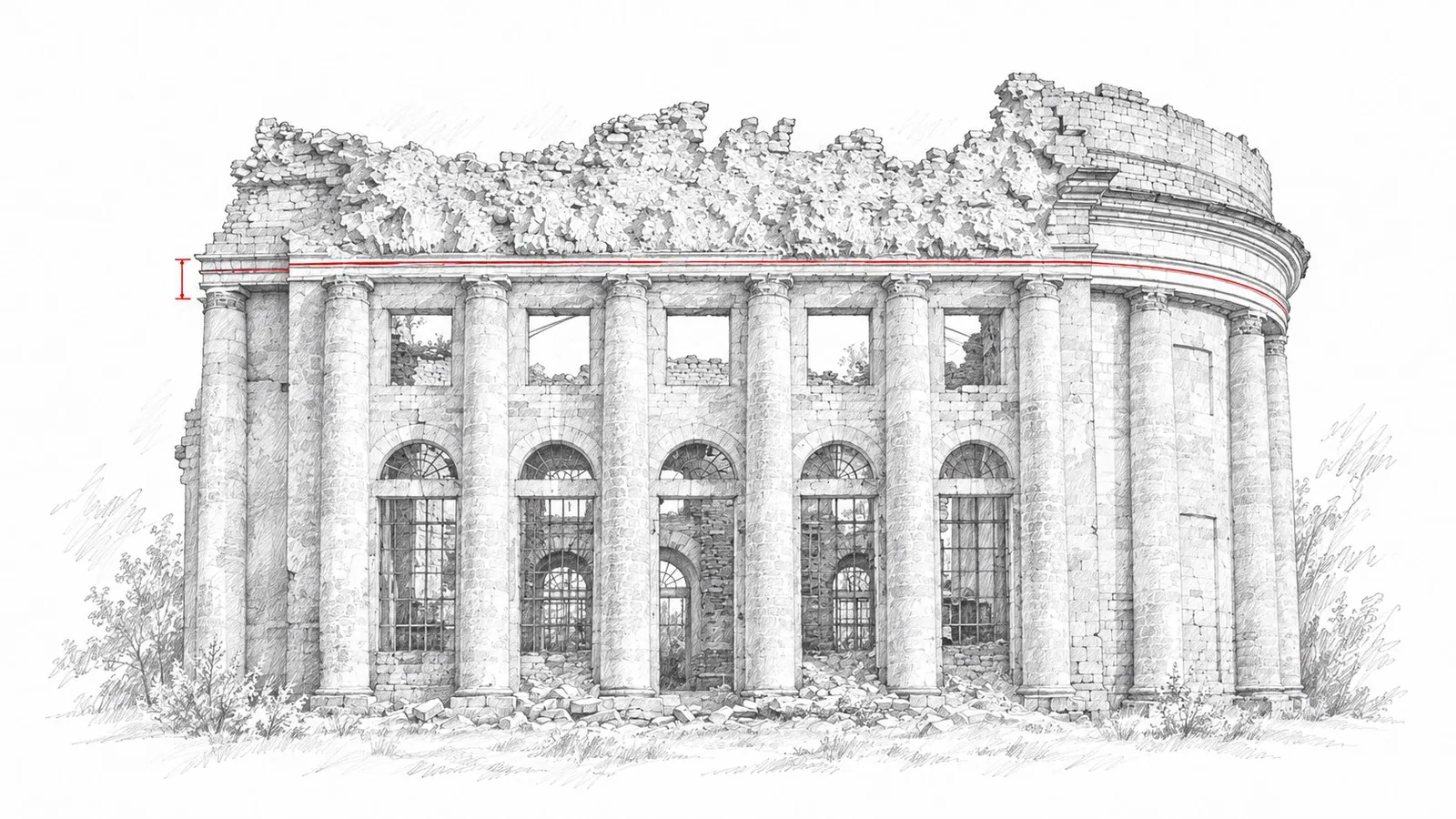
Scroll down: an oval church ringed with columns rises on the hill of the former manor, a cutaway reveals its brick columns, it loses its dome and a portico, and at the end it stands under the temporary conservation roof.
- [01]1747-1805
Manor on the hill
The Pyataya Gora manor has been known since 1747; a 1770 map calls it “Pyatogorskaya manor”. In 1805 the estate is bought by Senator Fyodor Briskorn: on the hill stand a wooden manor house and stone outbuildings, and a park, a garden and ponds are laid out.
- [02]1827-1831
Rotunda church
The senator's widow, Olga Briskorn, asks for permission to build a stone church so that the peasants no longer have to walk five or six versts (about 6 km) to Dylitsy. On the hill, visible from every side, rises the oval Church of the Holy Trinity with a ring of Ionic columns, porticoes and semi-rotundas. It is consecrated in 1831; the architect is unknown.
- [03]
Brick, stone and springs
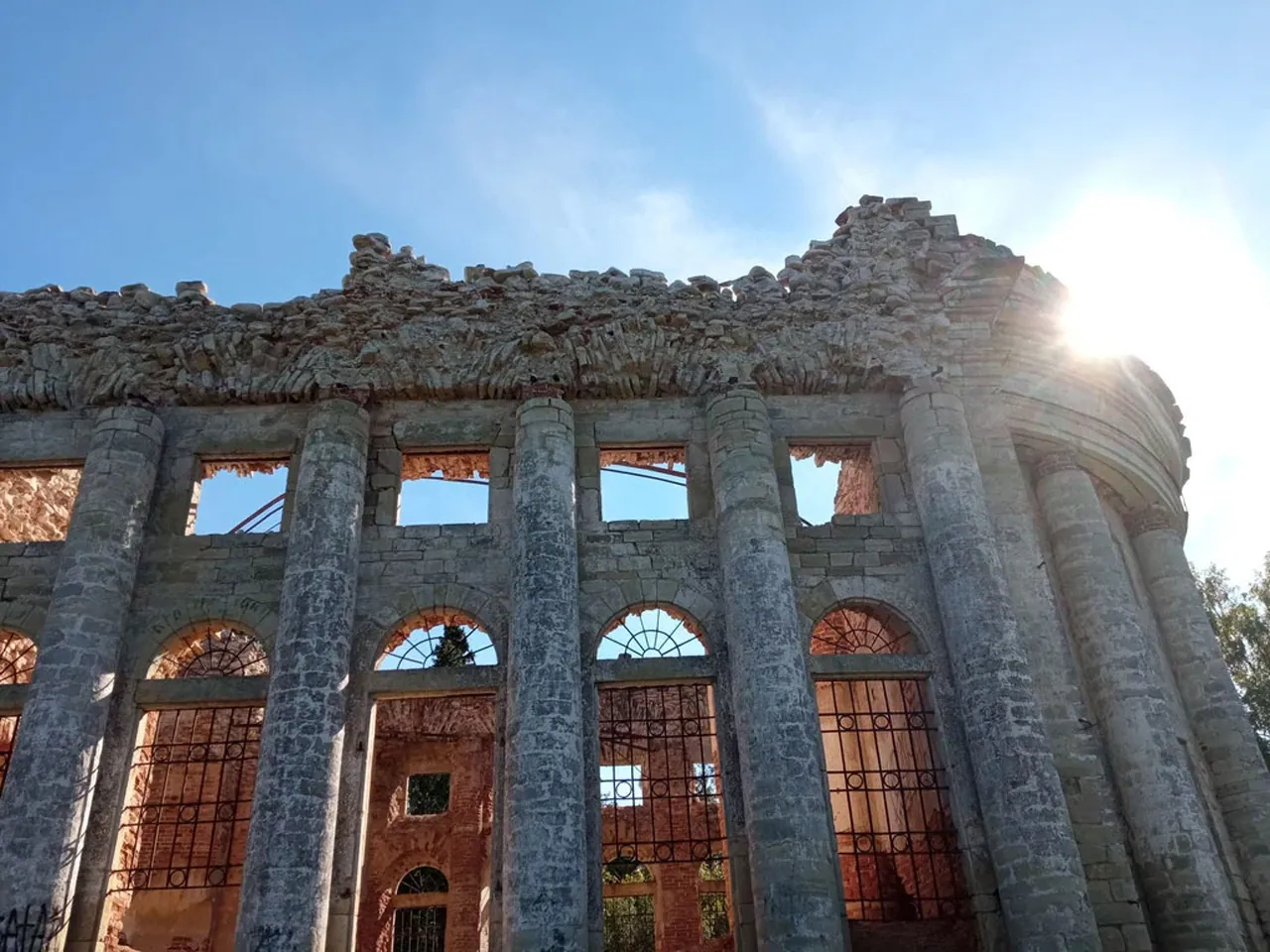
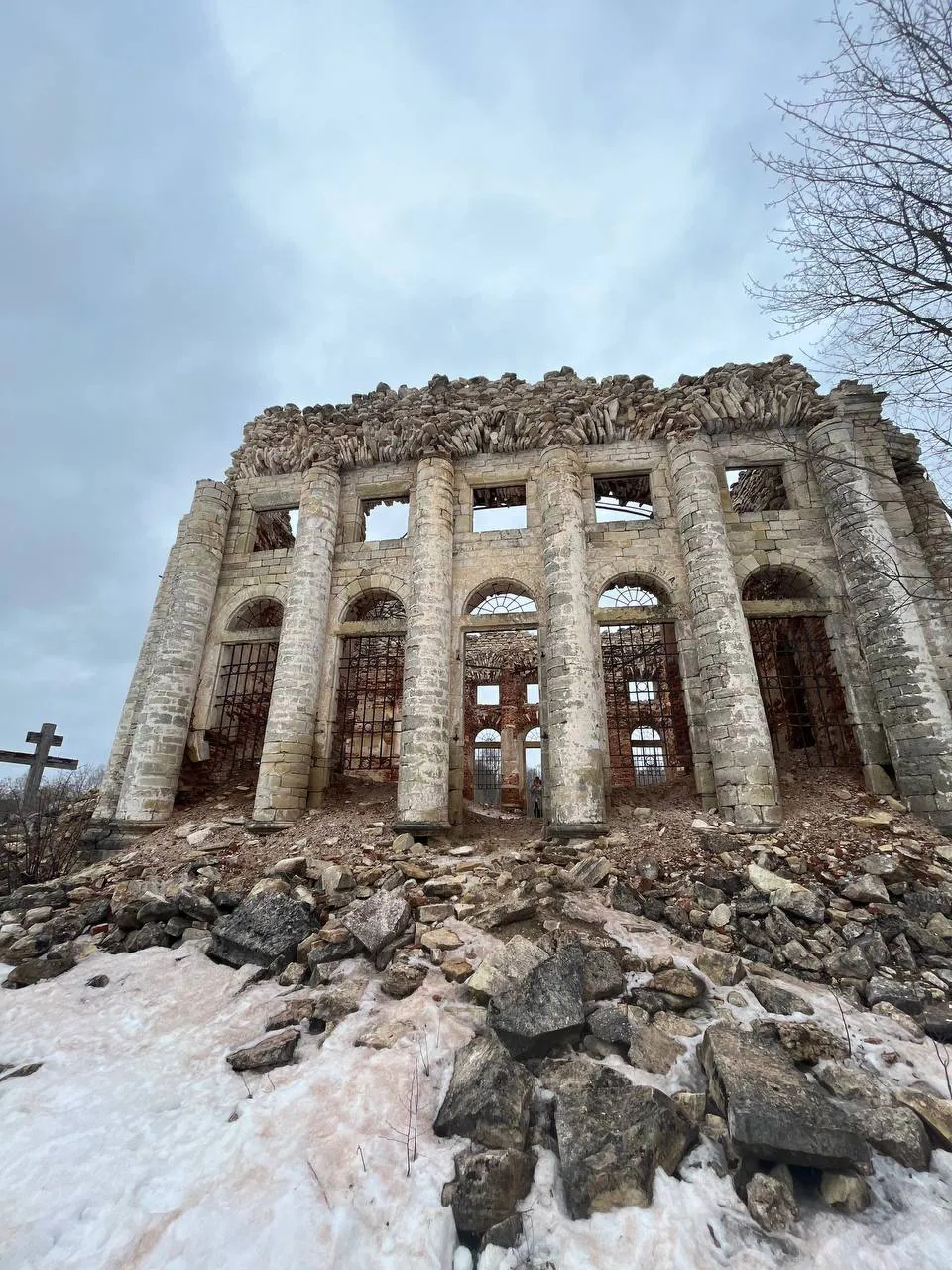
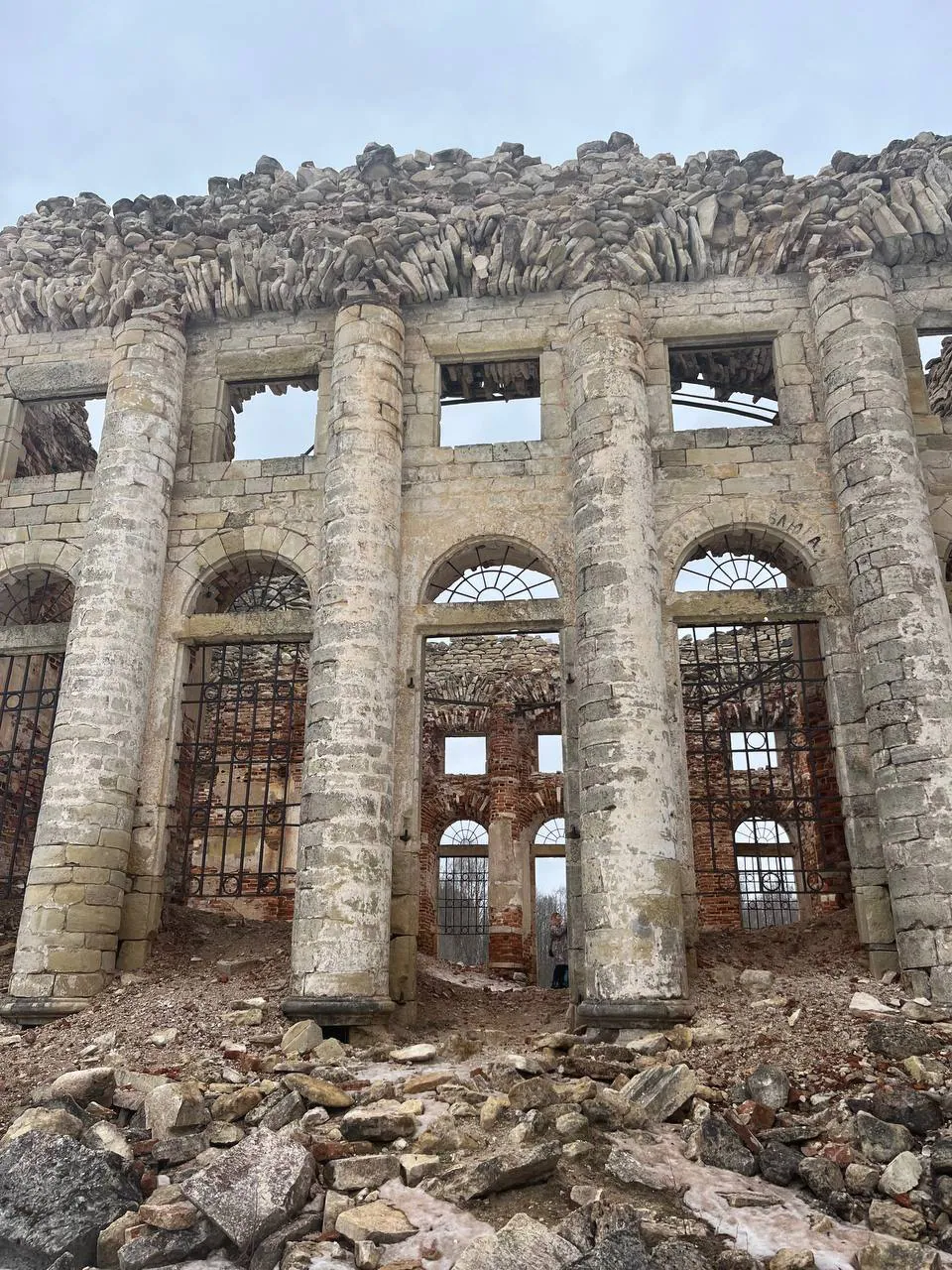
The columns are built of red brick, the walls of brick and soft local stone under plaster. As early as 1889 springs are undermining the foundations, and through-cracks run across the dome.
- [04]1879-1902
Cracks and repairs
In 1879 the parish is abolished and the church is attached to the church in Dylitsy. In 1891 the roof is repaired, and in 1902 the church is given a major overhaul: the foundations are strengthened, the cracks in the dome are filled and the facades are whitewashed.
- [05]1941-1960
Without a dome
In 1941, at the start of the war, services are still being held; sources disagree on when the church was closed. In 1960 the dome is pulled down with tractors, and without a roof the soft stone quickly decays.
- [06]2007-2010s
Collapses
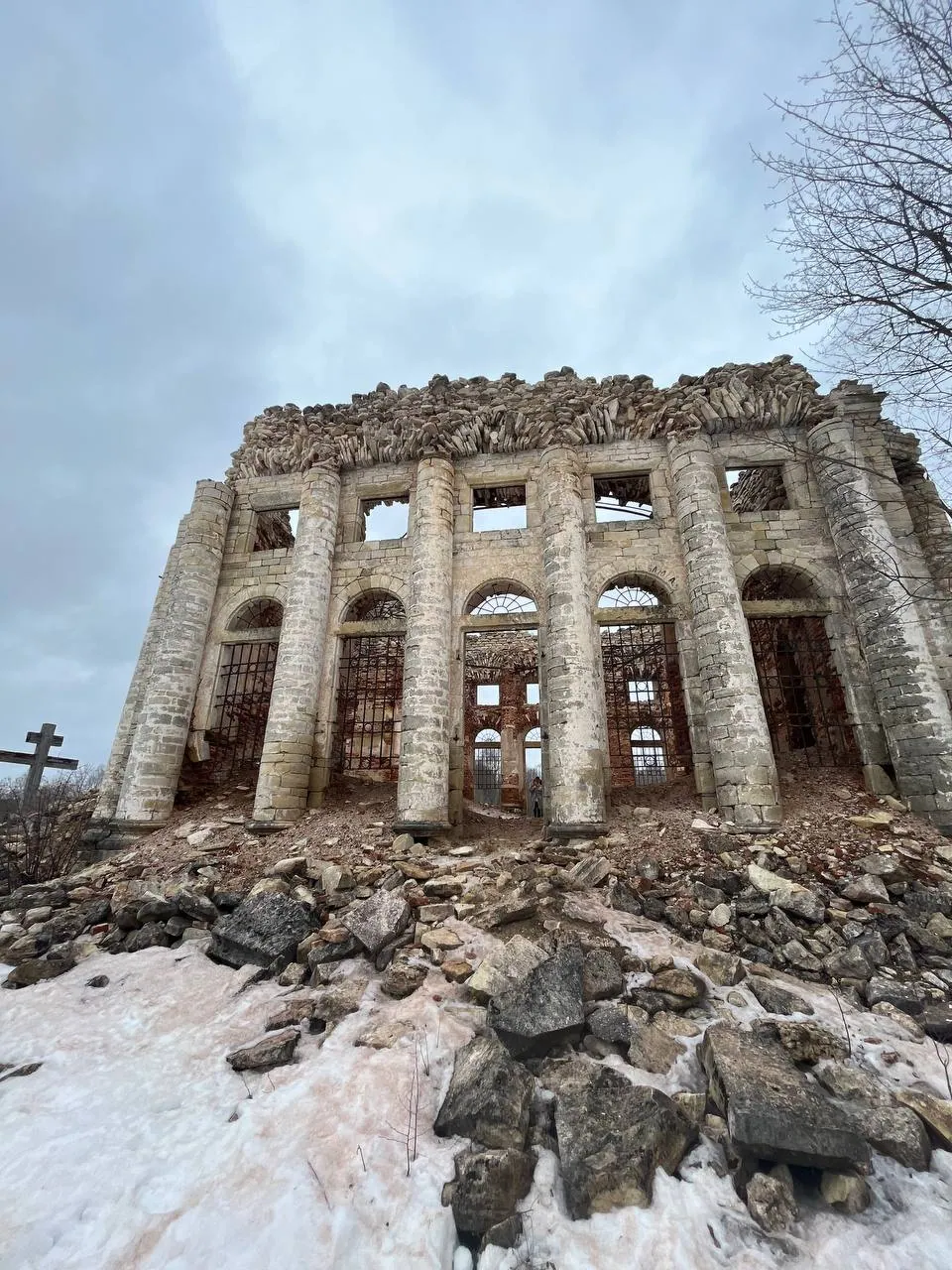
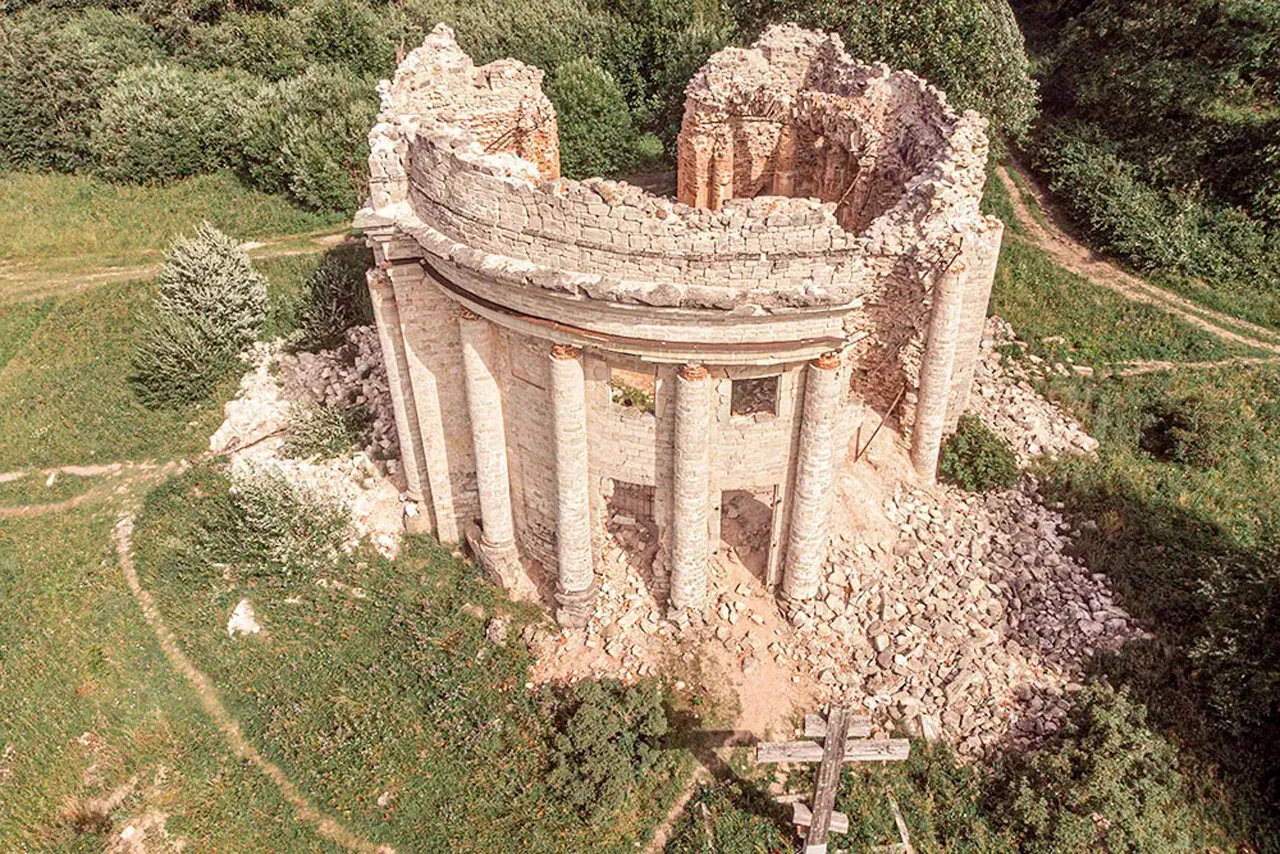
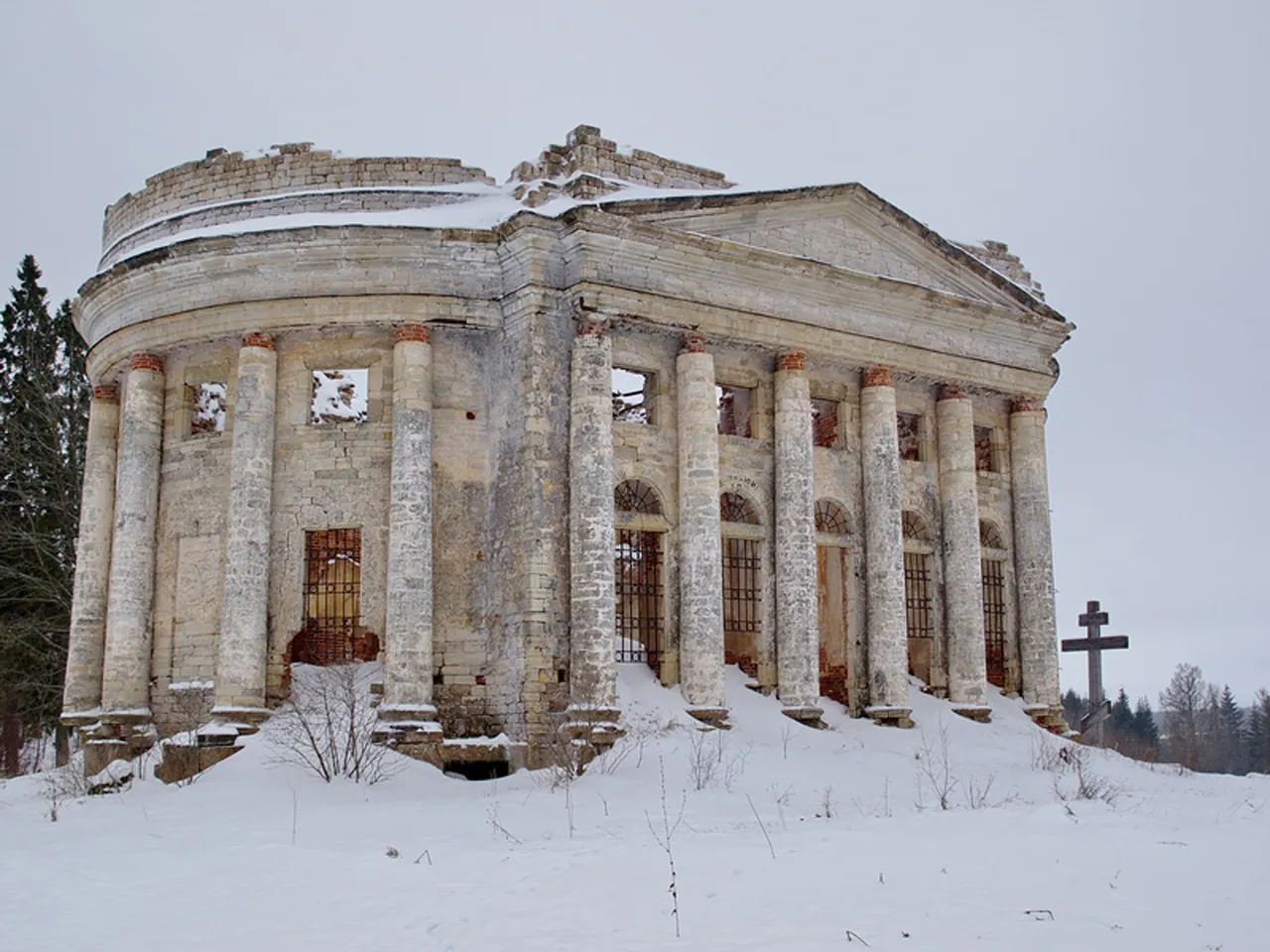
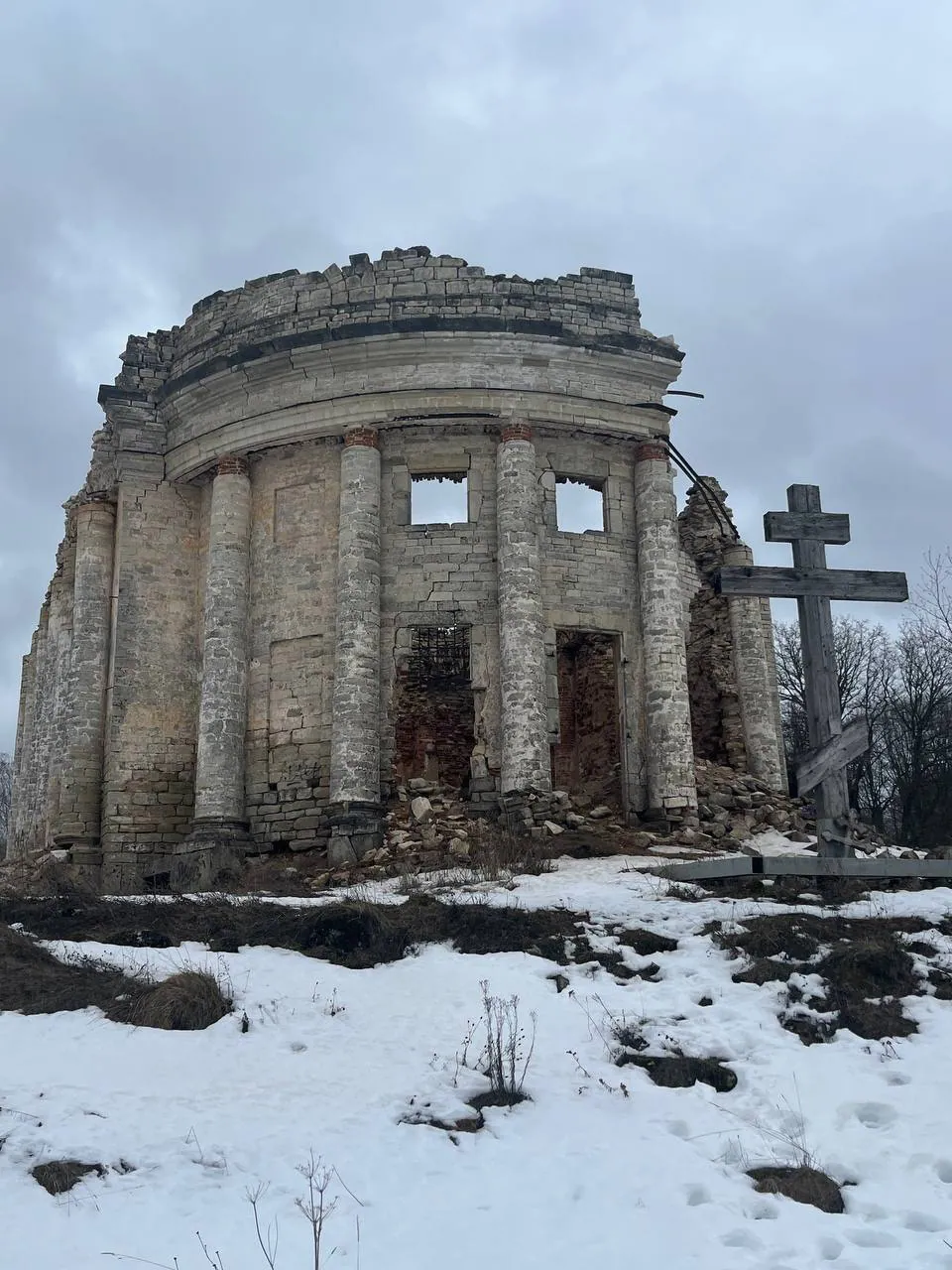
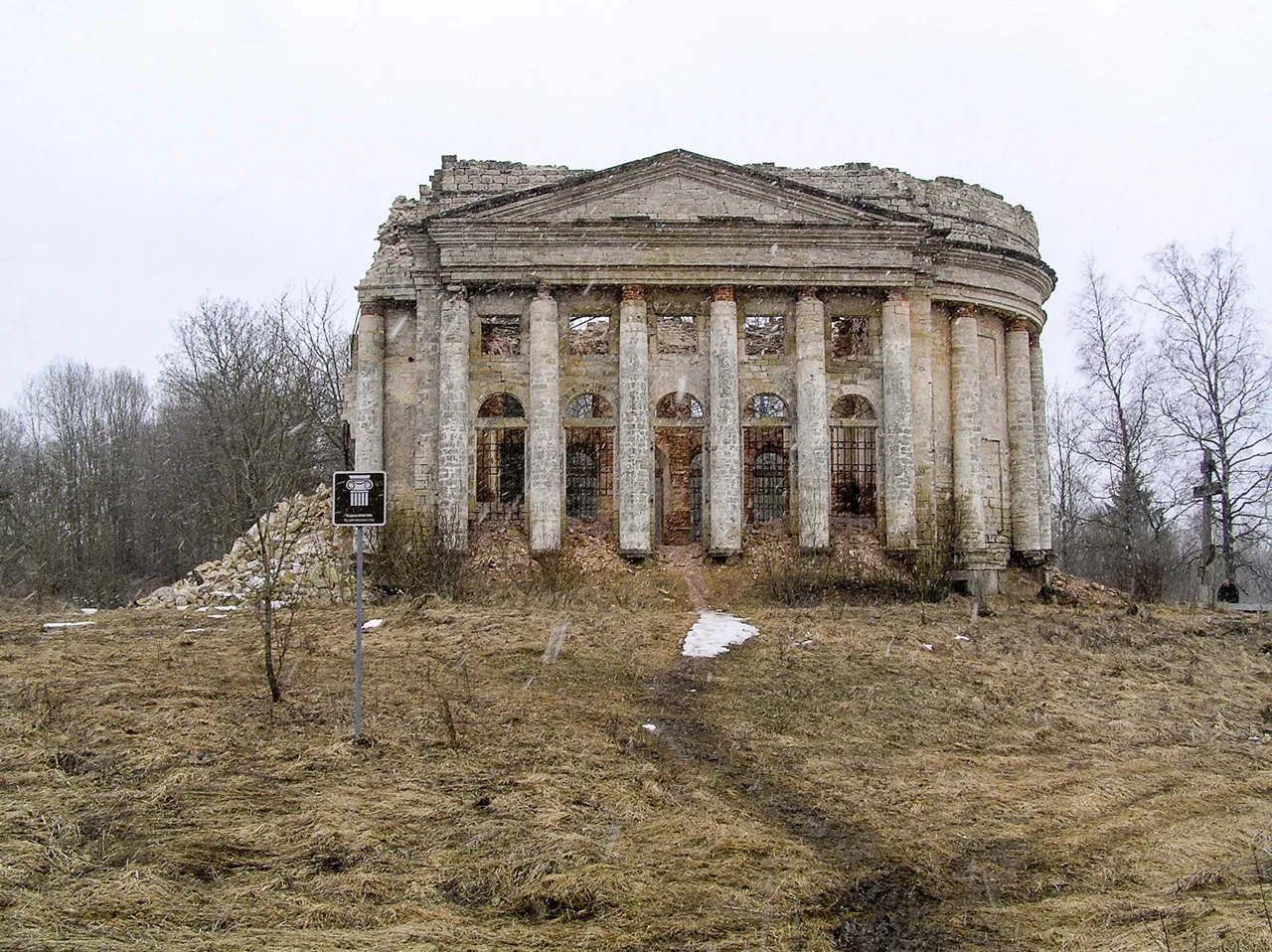
In 2007 the south portico collapses, and in the 2010s the west and east semi-rotundas and the pediment of one of the porticoes follow. Heaps of fallen stone lie by the walls.
- [07]2023
Conservation
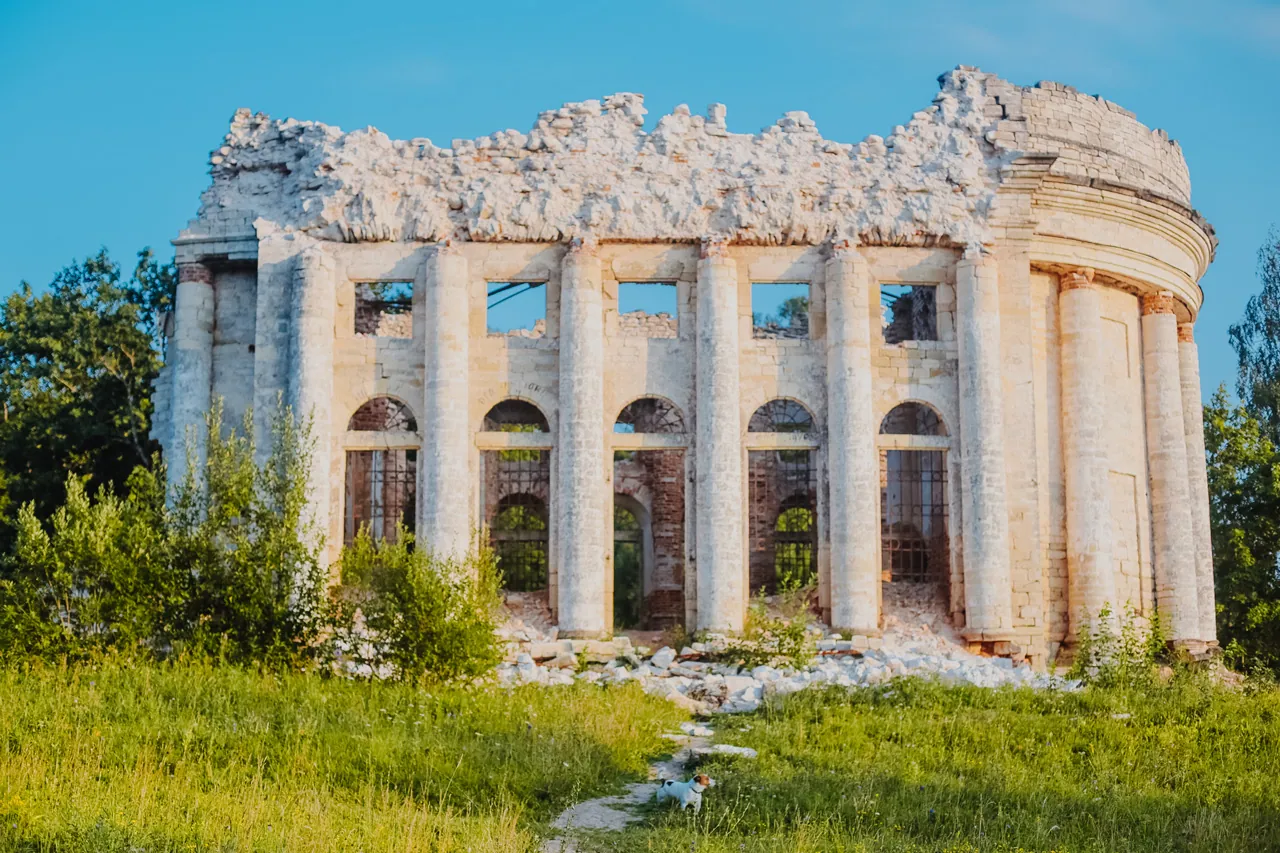
The estate is a heritage site of regional significance. In 2023 conservation work on the estate was completed to prepare it for full restoration. The eroded columns are reinforced with modern brick, and the ruin stands under a temporary roof on a timber frame.
The model is based on open data and checked against photographs: the outline and surroundings come from OpenStreetMap, the drum, dome and lantern as they were before 1960 from 1930s-1940s photographs on PastVu, the description of the church from Sobory.ru, and the history from a 2016 SPbGASU article and Wikipedia. No measured drawings are publicly available: the plan, dimensions and heights are estimated from photographs; the rubble, frame and temporary roof are simplified.
Role: conservation designer
A small private Colosseum near St Petersburg with a unique history. Strengthening the historic masonry with steel structures to preserve it for future restoration.
The dream is to get a building like this for actual restoration. A true miracle would be to adapt Pyataya Gora for modern use. Investors, answer the call! This monument of incredible beauty needs loving care and is ready to share its unique aura with a modern and careful adaptation.
We managed to complete the conservation design, for which, as often happens, we were paid later. A year later. Under a writ of execution based on an arbitration court ruling. The lesson learned: liking a project does not mean you will like the client.
Trinity Church was built in 1826 at the insistence of Briskorn's widow, the landowner Olga Briskorn, who five years after her husband's death petitioned the Church Consistory for permission to build a church on the estate.
Large quantities of a soft sedimentary rock, quarried right here at the Kyurlevsky quarry, went into building the church. That is exactly why the church keeps subsiding, first to one side, then to the other, giving the impression of a very ancient building of which only the walls remain. It is hard to imagine that as late as the 1960s the church was still active and services were held in it.
In its heyday Trinity Church was a real beauty. The building was an oval ringed with Ionic columns. Inside, a good dozen columns adorned it; to the south and north stood six-column porticoes, and to the east and west, semi-rotunda apses. The unknown architect created a truly unusual building that looked more like a temple of antiquity than an Orthodox church.
The village of Pyataya Gora is first mentioned on the map of St Petersburg Governorate drawn up by Ya. F. Schmit in 1770, where it is called “Pyatogorskaya manor”. In 1834 F. F. Schubert compiled a map of the governorate and named the village “Pyataya Gora Briskorn”. In 1885 the village had 8 households. According to the census, a century and a half later, in 2010, it had 20 inhabitants.
The Pyataya Gora Estate is a heritage site of regional significance.
In 2023 conservation work on the estate was completed in preparation for subsequent full restoration.
The Pyataya Gora manor has been known since 1747; Ya. F. Schmit's map of 1770 calls it “Pyatogorskaya manor”. In 1805 the estate was bought by Senator F. M. Briskorn, formerly secretary of state to Paul I. The estate had a wooden manor house, stone outbuildings, a park, a garden and ponds on the hill.
After the senator's death in 1824, his widow O. K. Briskorn asked for permission to build a stone church: the Orthodox peasants had to walk five or six versts (about 6 km) to Dylitsy. The Church of the Holy Trinity was completed by March 1830 and consecrated on 8 February 1831; other sources say it was built in 1826. The oval church, with Ionic columns around its perimeter, six-column porticoes to the south and north and semi-rotundas to the east and west, looks more like a temple of antiquity than an Orthodox church. Two other Briskorn churches, in Kursk and Yekaterinoslav Governorates, share its design; the architect is unknown.
The soft local stone let the church down: in 1889 springs undermined the foundations and cracks ran across the dome, and in 1902 the church underwent a major overhaul. In 1960 the dome was pulled down with tractors, and without a roof the walls began to decay quickly. In 2007 the south portico collapsed, and in the 2010s the semi-rotundas and the pediment of one of the porticoes followed.
In 2015 the estate, with its church, park and a farm building, was entered in the register of heritage sites of regional significance, and that same year students of the St Petersburg State University of Architecture and Civil Engineering (SPbGASU) measured the ruin. In 2023 the church was included in the federal “Conservation” project: the eroded brick columns were reinforced with modern brick, and the regional heritage protection committee decided that the right course was to preserve the church as a ruin. Today the ruin stands under a temporary roof on a timber frame.
Sources:
- Sobory.ru: Trinity Church in Pyataya Gora
- SPbGASU: history of Trinity Church at the Pyataya Gora Estate
- Smotrim: efforts to save Trinity Church in Leningrad Region
- Wikipedia: Pyataya Gora
- Wikivoyage: cultural heritage, Volosovo District
- PastVu: Pyataya Gora, Trinity Church, 1930
- OpenStreetMap: church outline
Photos of the building
Other projects
discuss your project
+7 (989) 577-75-77Elena, office administrator
info@endovitckii.ruOffice2 Krylatskaya Street, Moscow
The administrative building on the Rowing Canal, gallery, floor 3, offices 10-12.
Free parking. Passes are arranged through the office administrator.