Project budget and schedule: preparation and monitoring
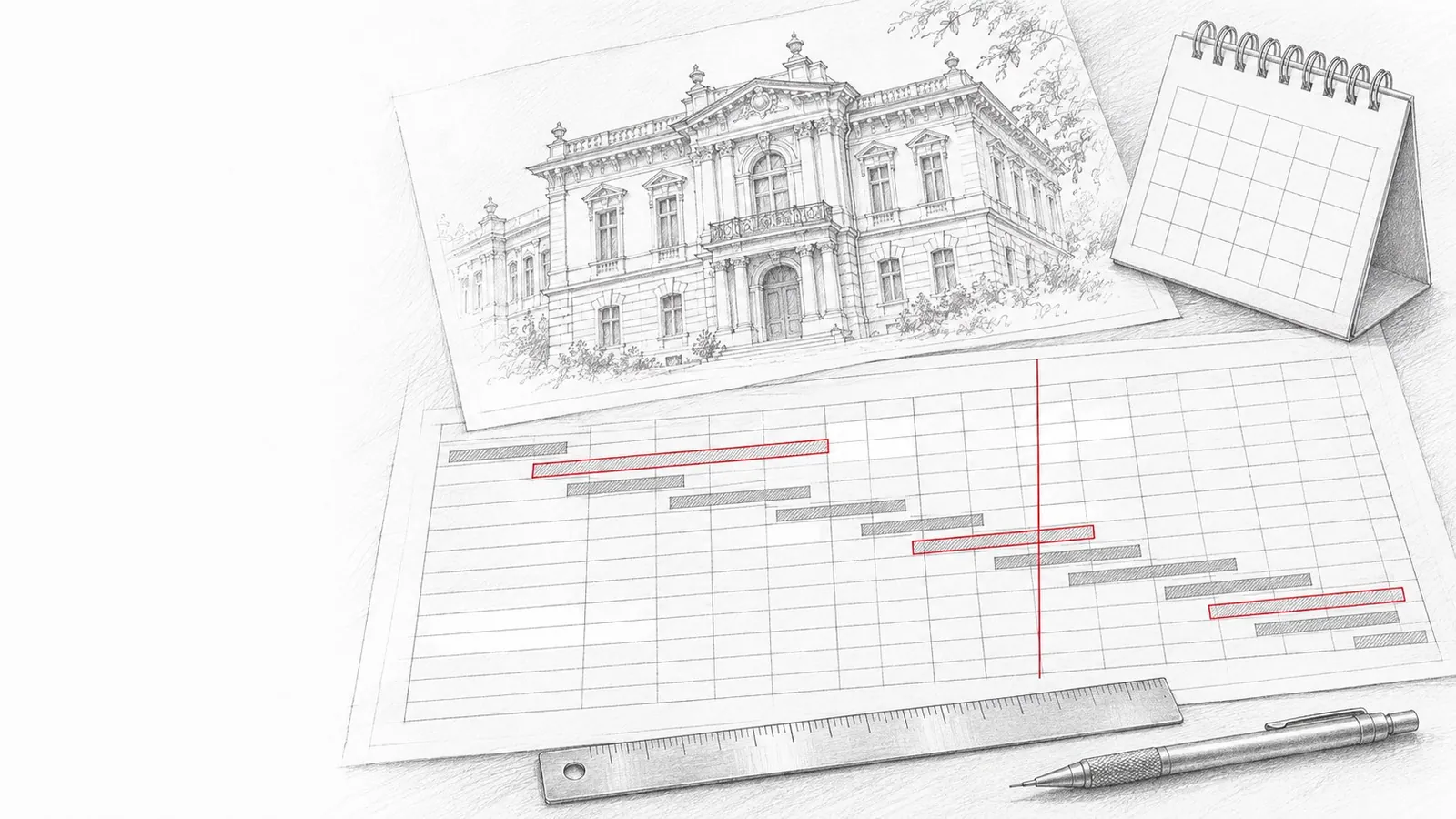
The two main coordinates of any project are timing and budget. When contractors act out of step, the project loses pace and money goes on rework. The project schedule must take into account each contractor's deadlines, the links between them and the order in which the stages are done. Don't forget the time the client needs to review decisions, or the administrative approval procedures. The schedule must show the real picture, not what the client wants to see. Defending the timeline with sound arguments at the start is better than dashing the client's expectations at the finish.
A project budget is not the estimated cost. It is the sum of all the costs of the contractors brought in, purchases of materials and equipment, and state fees and duties. A properly drawn-up budget is a proven remedy for extra works and nasty surprises.
Four elements of the deal
After years of intensive work, we arrived at four mandatory elements of a deal with a client. The Terms of Reference, the Contract Price Agreement Protocol, the Works Schedule and the Funding Schedule.
The last two schedules are two systems of coordinates. Any spontaneous change to this system always has negative consequences. Always. Even when it is about speeding the work up. Especially when it is about speeding up. Any acceleration of the agreed schedule does not automatically bring accelerated funding. But it is absolutely certain to lead to mistakes and tension in the team. So when we come up against a client with a gung-ho Komsomol mindset, for the first couple of months we systematically turn down every offer to shorten the timeline. It is very important to be able to say “no” at the right moment in situations like this. Working in firefighting mode is fine at a fire, or for catching fleas.
How we came to stage payments
In those distant days when the trees seemed taller and all clients were lovely people, we worked on 50/50 terms. And it took us a while to realise how important it is to keep the risks balanced with the client throughout the project. After yet another court case with a client who forgot to pay for the design we had prepared, we began to suspect something. The next hint was a new client's demand that the advance we had received be secured with a bank guarantee. And then it dawned on us. Why not apply the construction principle to paying for design? A small advance of up to 25% of the contract price, with stage-by-stage sign-off and the advance offset in each stage in proportion to the amount paid. We went further and broke the whole project down into self-contained parts, each with its own advance and sign-off. And that gave us a balanced schedule in which paperwork and money meet every month. This let us cut our financial risks and feel incredibly clever and cool.
Three service blocks
discuss your project
+7 (989) 577-75-77Elena, office administrator
info@endovitckii.ruOffice2 Krylatskaya Street, Moscow
The administrative building on the Rowing Canal, gallery, floor 3, offices 10-12.
Free parking. Passes are arranged through the office administrator.